Controls how sound is perceived
Volumetric Wavefield Synthesis
A method of reproducing sound so that spatial imaging, level and frequency response are consistent for every listener within a defined volume — sound that originates inside the listening space rather than at its edges.
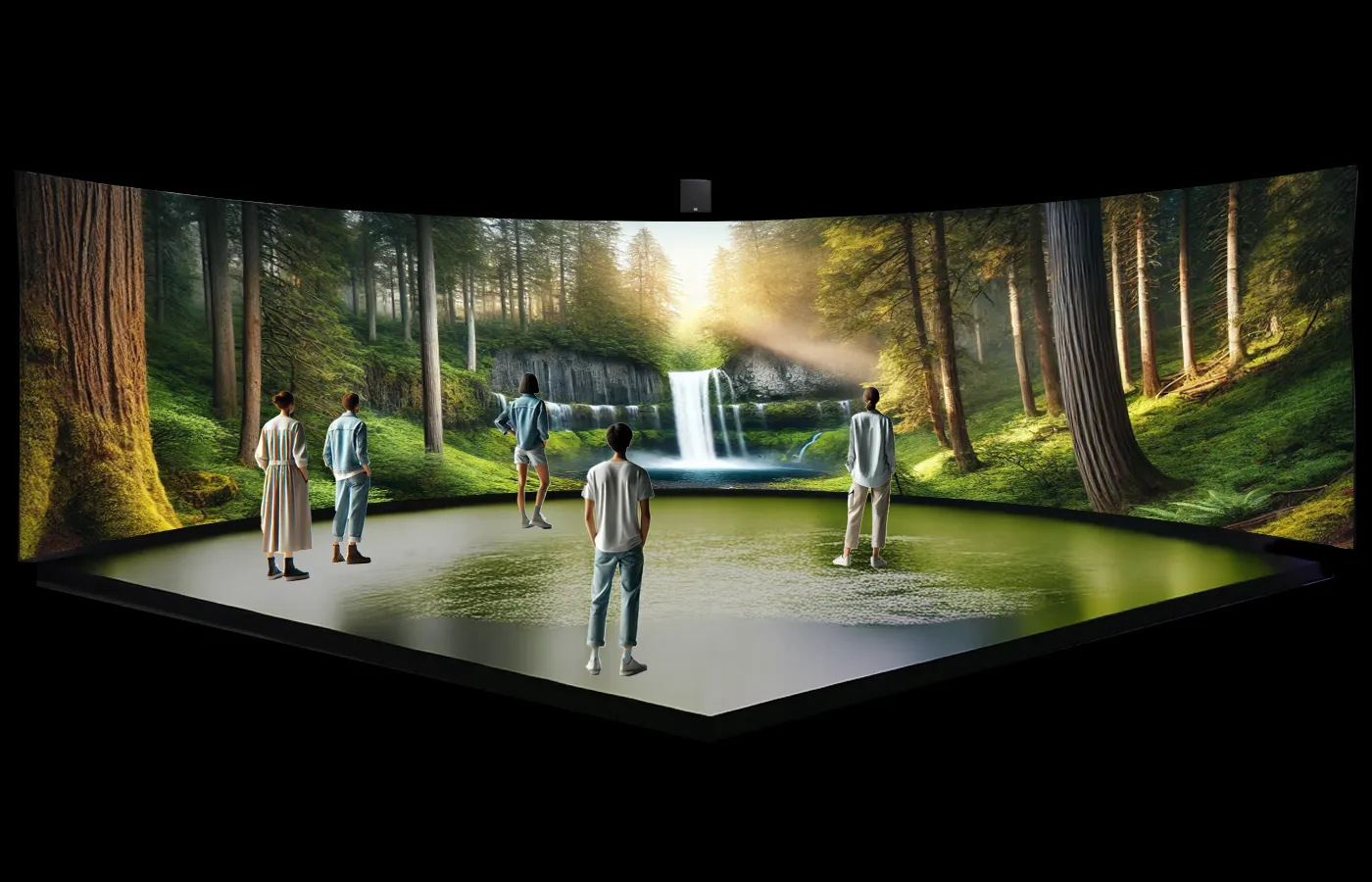
Volumetric Wavefield Synthesis is a method of reproducing sound so that spatial imaging, sound pressure level and frequency response are consistent for every listener within a defined three-dimensional space. It is an alternative to conventional stereo, surround and immersive systems: rather than optimising sound for a single listening position, it regenerates the intended auditory experience independently for each listener. The result is stable, hyper-realistic localisation and immersion throughout the entire listening area.
Sound & Video Contractor named EDC’s Volumetric Wave Field Synthesis a Best of Show winner at InfoComm 2025.
Why conventional systems create sweet spots
Stereo, surround and object-based systems rely on fixed loudspeaker locations. Correct spatial imaging occurs only when the listener is at specific distances from those loudspeakers. As the listener moves, arrival time shifts, level changes, frequency response is altered and spatial cues collapse. The result is a narrow region of accuracy surrounded by progressively degraded listening.
Boundary-limited reproduction
All conventional stereo, surround and immersive systems are boundary-limited: sound can only originate from the edges of the listening space. Loudspeakers sit at the perimeter and radiate inward. However many loudspeakers are added, sound always enters the space from outside, each listener experiences a different geometric relationship to those boundaries, and the sound field collapses differently at every position. The limitation is fundamental.
Sound originating within the space
Volumetric Wavefield Synthesis removes the boundary limitation. Sound sources are generated within the listening space itself. Rather than projecting sound inward, the system reconstructs the sound field throughout the volume, so listeners are surrounded by a regenerated auditory environment and spatial cues no longer depend on proximity to a physical loudspeaker.
The wavefield principle
Multiple sound sources are distributed throughout the listening volume. Each contributes a controlled component of the overall sound field, coordinated in time, amplitude and spectral content. Together they regenerate the intended sound image continuously through the space — a perceptual wave rather than a fixed wavefront.
Directional control using end-fire principles
Accurate localisation needs controlled directionality as well as spatial reconstruction. Volumetric Wavefield Synthesis incorporates end-fire array principles in its algorithms: time-aligned source sequencing reinforces propagation in a chosen direction while suppressing it in others. Within the volumetric framework these principles are applied algorithmically rather than mechanically, so directional cues are preserved even though sound originates inside the space. Directionality is enforced perceptually, not implied geometrically.
Regeneration for every listener
The system does not distribute one shared sound field. It regenerates the intended sound image independently for each listener: level, frequency response and directional cues are recalculated for each position, and end-fire principles keep directionality correct for each of them. Consistency is not averaged. It is enforced.
What it delivers
- Consistent spatial localisation. Sources stay anchored; direction and depth stay stable; listeners perceive the source without searching for it.
- Consistent sound pressure level. Level is regenerated locally, so no listener is too loud or too quiet.
- Consistent frequency response. Spectral balance is preserved at every position; voices stay natural and music keeps its detail.
- Immersion without positional collapse. Spatial relationships remain coherent as listeners move.
- True stereo and immersive sound at scale. Left-right relationships stay correct across the whole audience. The traditional sweet spot disappears; the entire audience becomes the sweet spot.
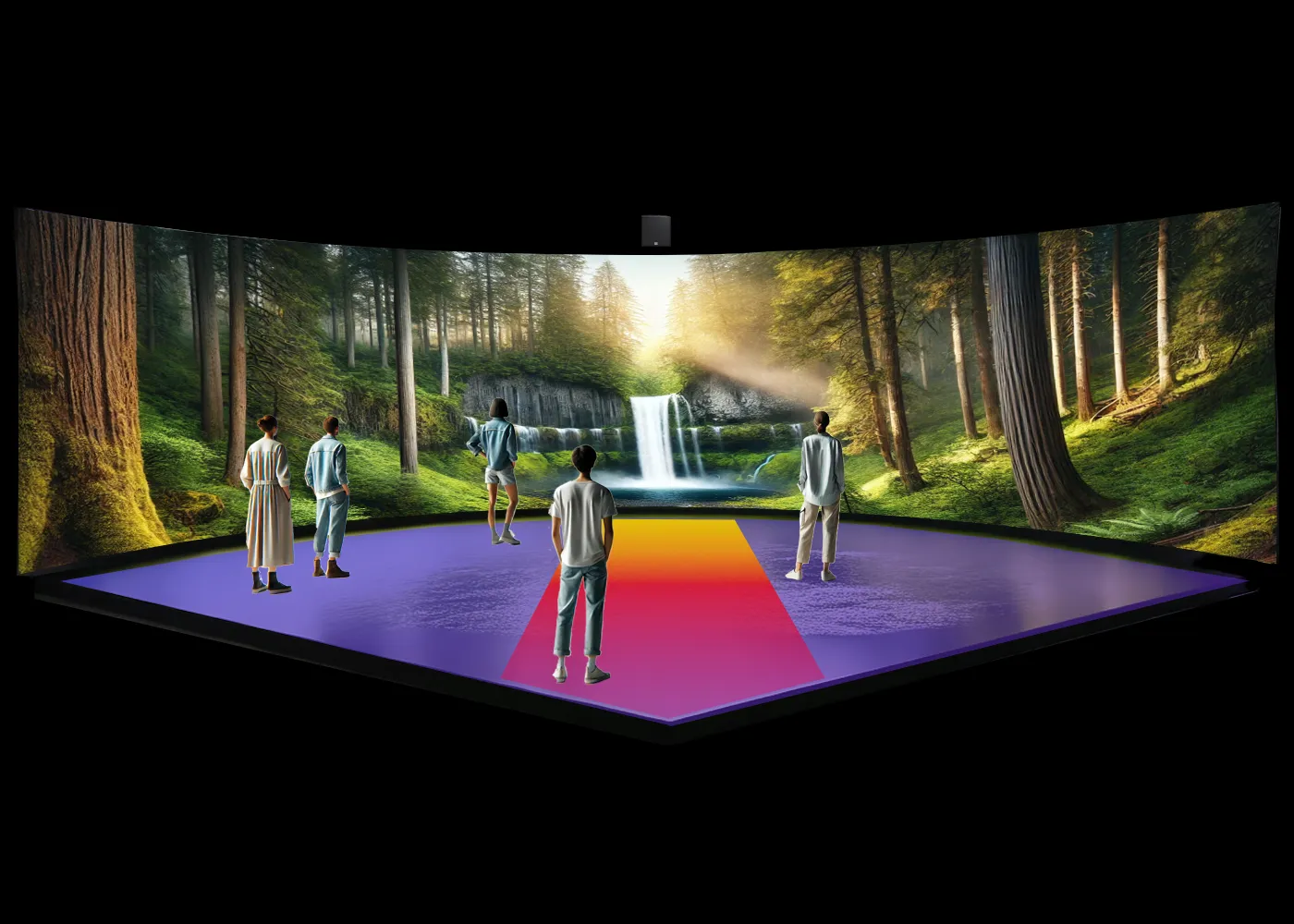
Where it is most effective
Immersive performance spaces. Theatres and auditoria. Museums and experiential installations. Simulation and training environments. Any space where perceptual accuracy and directional realism matter.
Systems are designed per project from EDC’s building blocks — see Volumetric Wavefield Synthesis systems and book a technical evaluation.
Questions designers ask
How is this different from surround or object-based immersive audio?
Where is it used?
Is there a standard product?
Next step
Hear what happens when nothing else interferes.
An EDC session is a technical evaluation of sound behaviour, not a sales demonstration. See reflections reduced, coverage stabilised and spatial accuracy preserved — modelled first, then measured.