Controls where sound does not go
Coming soonOctoid & Quadoid radiation
Loudspeaker technologies that confine sound to a defined fraction of a sphere — a quarter (Quadoid) or an eighth (Octoid) — across the full audio band, in a compact form. New technology, coming soon.
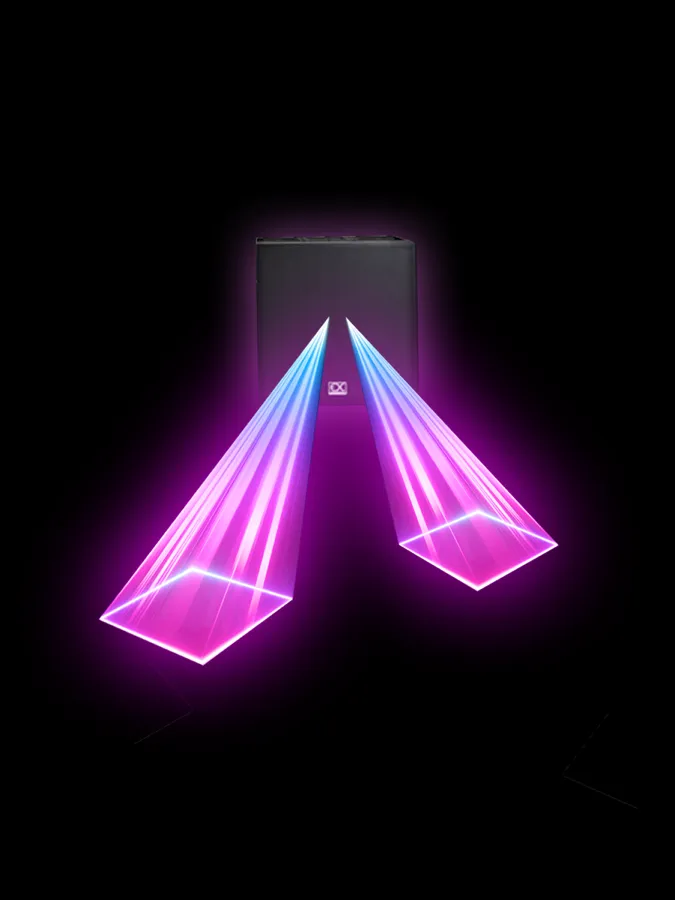
Octoid and Quadoid radiation are loudspeaker technologies designed to control precisely where sound is allowed to exist in three dimensions. Rather than radiating broadly and managing the consequences later, they prevent unwanted sound from being generated in the first place. Sound is confined to defined volumetric regions while the surrounding space remains acoustically unaffected.
The limitation of traditional radiation patterns
Conventional loudspeakers are described as omnidirectional, directional or cardioid. In practice these patterns provide limited and frequency-dependent control: high frequencies may be directional while low frequencies radiate almost omnidirectionally. Sound spreads into walls, ceilings and unwanted areas. Acoustic problems are created at the source, not by the room.
Broadband directional control has traditionally required large arrays or horn-loaded systems that depend on physical size, are visually intrusive, and even then control only one or two dimensions.
Defined three-dimensional containment
Octoid and Quadoid radiation define sound propagation volumetrically. Quadoid radiation confines sound to one quarter of a sphere. Octoid radiation confines sound to one eighth of a sphere. These regions are defined three-dimensionally, not just horizontally or vertically. Sound exists only where it is intended to exist.
Measured reduction of acoustic energy
For many years the industry benchmark for directional control has been the cardioid pattern, which reduces rearward radiation by approximately half compared with an omnidirectional source. Quadoid radiation, by confining sound to a quarter of a sphere, reduces the total acoustic energy radiated into the space by half again compared with cardioid. Octoid radiation extends the principle further: one eighth of a sphere, and one quarter of the energy of a cardioid pattern. The reduction is geometric, predictable and broadband.
What this level of control enables
Broadband directional control across the audible range. Significantly reduced reflections, reverberation and echoes. Reduced spill into adjacent spaces. Precise placement of sound only where it is required. Clarity that improves without an increase in volume.
Reducing the total energy radiated into a space also changes how sound is perceived: it becomes localised rather than pervasive. Listeners outside the intended region are minimally affected, so sound can be delivered to an individual without intruding on others — engaging, focused and non-obtrusive, and ideal for personal listening.
Where it applies
Museums and galleries. Interactive exhibits and self-guided tours. Transportation hubs. Retail and experiential environments. Any space where sound must be controlled as precisely as light.
Two models have been announced for launch — the ISS-8 and ISS-16 — and are listed on the Octoid & Quadoid loudspeakers page with pre-release figures.
Questions designers ask
When will Octoid and Quadoid loudspeakers be available?
How does this compare with a cardioid loudspeaker?
Next step
Hear what happens when nothing else interferes.
An EDC session is a technical evaluation of sound behaviour, not a sales demonstration. See reflections reduced, coverage stabilised and spatial accuracy preserved — modelled first, then measured.