Controls where sound goes
3D Beamforming
A method of controlling acoustic radiation in three dimensions so that every listener receives the same level, the same frequency response and the same spatial image — and the room is left out of it.
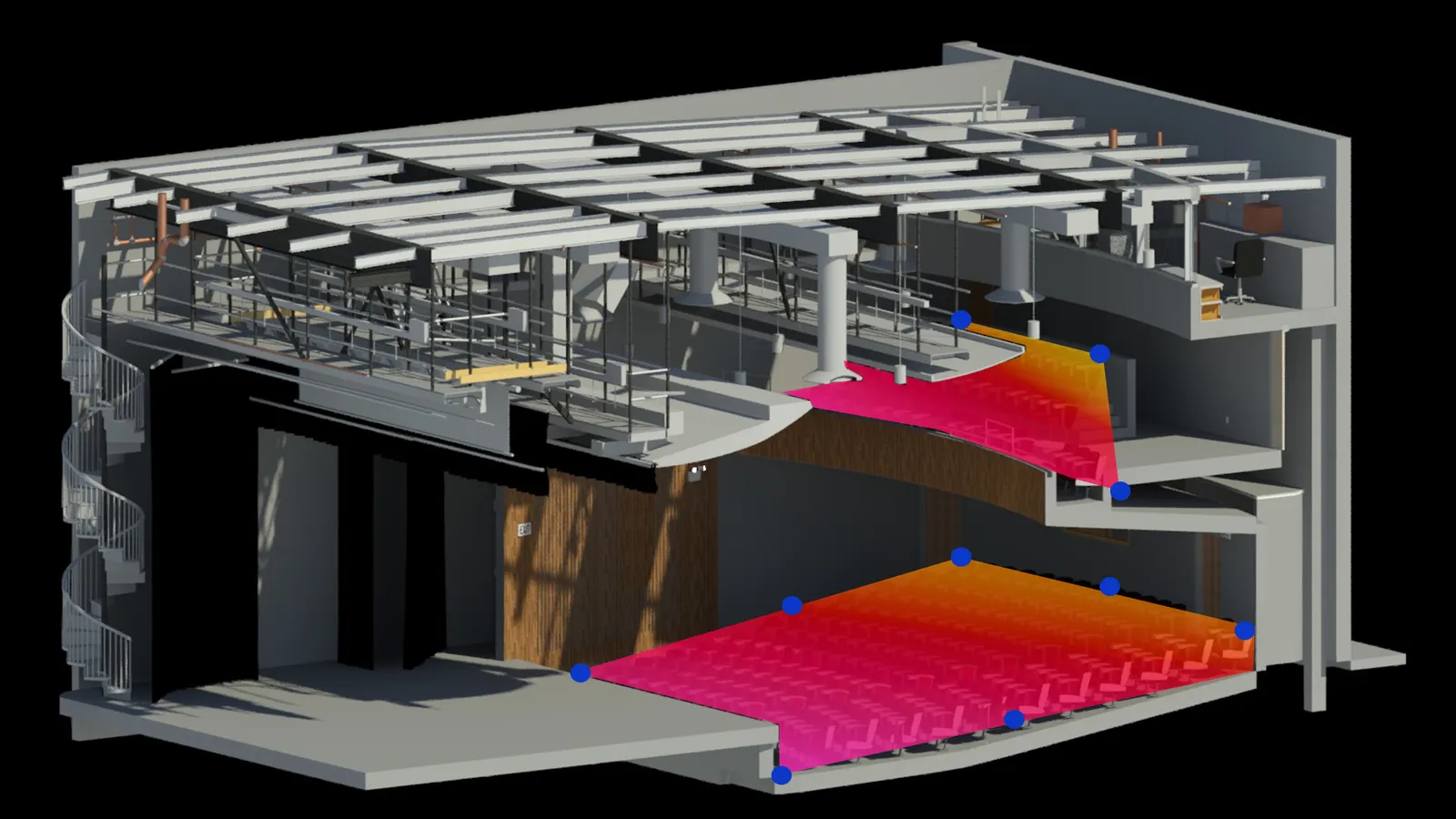
3D Beamforming is a method of controlling acoustic radiation in three dimensions to deliver predictable, uniform sound across an entire audience. It is not simply a way to aim sound. It is a way to control how sound behaves spatially, so that every listener receives the same intended experience.
It addresses four fundamental challenges in sound-system design: consistency of sound pressure level, consistency of frequency response, consistency of stereo and immersive localisation, and the reduction of unwanted acoustic interaction with the room.
Audience areas are three-dimensional
Real audiences are not arranged along a single line or plane. They occupy wide, irregular, three-dimensional regions of space. Listeners at the far sides of a venue are often significantly farther from the loudspeaker than listeners near the centre, and height differences increase the variation in distance and arrival time further. Any system that optimises sound along only one dimension ignores the true geometry of the audience — and that oversimplification is the root cause of inconsistent sound quality in most venues.
The limitation of conventional point-source loudspeakers
Traditional loudspeakers are point sources. They radiate outward in broad patterns with limited ability to control where acoustic energy travels; coverage is achieved by mechanical aiming and physical placement. Once sound leaves the loudspeaker it is free to interact with the room. Walls, ceilings and floors are excited before sound reaches many listeners, producing early reflections, reverberation and uneven coverage. Equalisation, processing and acoustic treatment then manage the consequences. They do not prevent the problem.
As audience size grows the limitations become more severe. Listeners close to the loudspeaker hear too much level; listeners far away hear too little, with altered tonal balance. Stereo imaging collapses away from the centreline. The sweet spot stays small.
The limitation of single-axis control
Conventional line arrays and electronically steered columns primarily control sound along one axis — front to back, managing how level decays with distance. Horizontal coverage is fixed by physical geometry and is not actively compensated, so listeners toward the sides, who are significantly farther away than listeners near the centre, receive inconsistent level, tonal balance and spatial accuracy. It is the same failure as conventional stereo, where accurate imaging exists only for the listener equidistant from both loudspeakers, extended across the whole audience.
Steered columns also pay for width with output. To broaden a beam they shade drivers down, apply low-pass filtering or use FIR filtering that introduces phase differences between sources; at wide settings a small proportion of drivers, sometimes one, may be doing the high-frequency work. That is why most steered products are confined to speech and background music.
Why 3D Beamforming is different
3D Beamforming accounts for the full geometry of the audience. Sound is shaped horizontally, vertically and in depth. Distance differences across the entire audience area are compensated, and sound pressure level, frequency response and timing are controlled for every listener. Rather than optimising for a single axis or a single position, the system optimises for the whole audience.
EDC’s implementation — the Plane Array algorithms — does this without shading or low-pass filtering to broaden the wavefront. Every transducer contributes full bandwidth at every beam width, and the outputs are held phase-constant across the array, so the wavefront stays coherent whether it is narrow or wide, and clusters of cabinets sum as a single source at all frequencies. Complex wavefronts can be curved, skewed, sloped and tilted to match an asymmetric audience, and each SC or SQ cabinet produces up to four of them independently.

What it delivers
Consistent sound pressure level. Acoustic energy is distributed so that listeners at different distances receive equivalent level across the full width and depth of the audience. Excess at the front is avoided; deficiency at the sides is eliminated.
Consistent frequency response. Distance and room interaction affect frequencies unequally. 3D Beamforming manages frequency-dependent behaviour alongside level, so every listener receives the same spectral balance — voices stay intelligible, music keeps its detail.
Consistent stereo and immersive localisation. Because horizontal and vertical distance differences are compensated, the timing, level and spectral relationships that carry spatial information survive across the audience. The sweet spot expands to include the whole room.
Less room. Energy that is not sent at walls and ceilings cannot come back as reflections. Reverberation is shortened, spill into adjacent spaces is reduced, and clarity improves without an increase in volume.
In practice
Coverage is designed in the EDC Pro App: audience areas are drawn in augmented reality at real scale in the venue, the system predicts level and response at thousands of listening positions, and the result is pushed to the cabinets over the network. See Software for the design-to-verification workflow, and the S-Series for the hardware.
Try it — drag the zones
Questions designers ask
Is 3D Beamforming the same as beam steering?
How many beams does one cabinet produce?
What is the coverage range?
Does broadening the beam reduce output?
Next step
Hear what happens when nothing else interferes.
An EDC session is a technical evaluation of sound behaviour, not a sales demonstration. See reflections reduced, coverage stabilised and spatial accuracy preserved — modelled first, then measured.