technology · November 21, 2024 · updated September 5, 2026
Plane Array explained: how it differs from line arrays, planar arrays and steered columns
The four comparisons EDC is asked for most — conventional loudspeakers, steered columns, planar arrays and line arrays — and what the Plane Array does differently in each case.
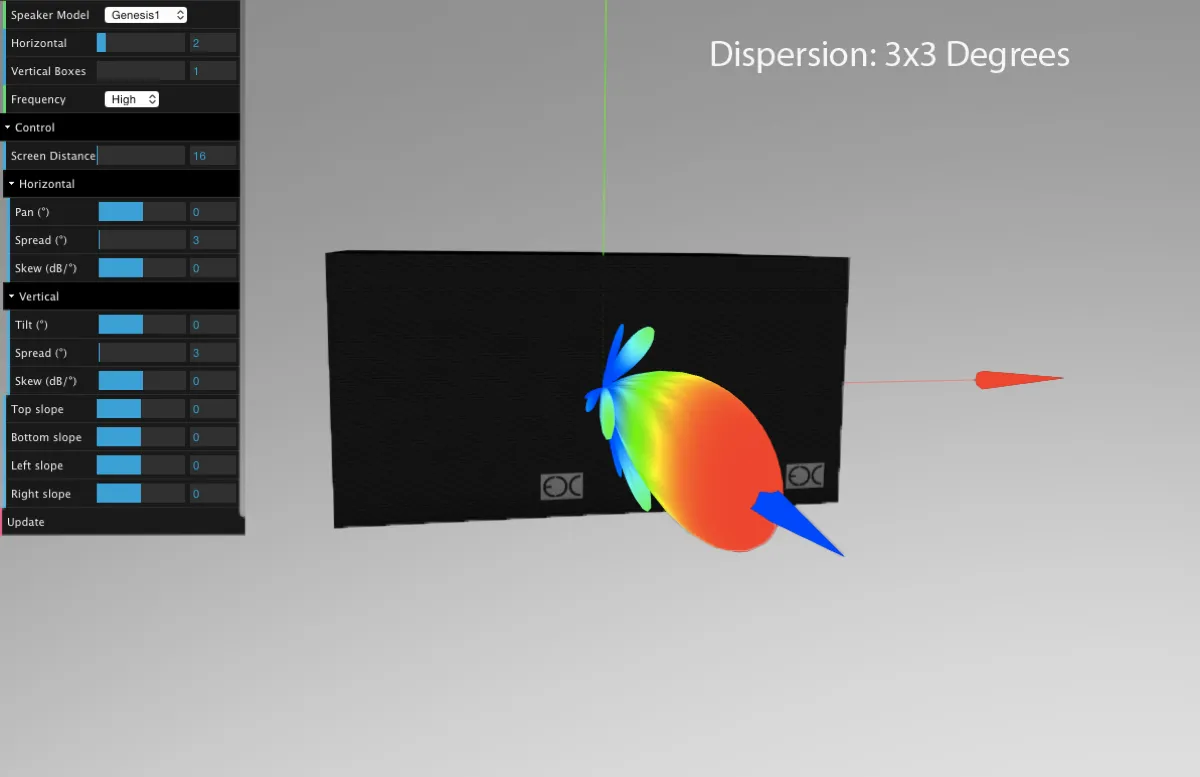
EDC’s Plane Array technology is the algorithmic foundation of the S-Series. Because it is often confused with technologies that share some of its vocabulary, this article sets out the four comparisons we are asked for most.
Conventional loudspeakers
A conventional loudspeaker is designed with a fixed horizontal and vertical pattern. When more level is needed a second cabinet is placed beside the first, and the operator aims each at a different part of the room to limit comb filtering. That gives low-frequency summation but negligible high-frequency summation: the system gets louder at the bottom, not at the top. Overlapping the horns instead creates constructive and destructive interference in the near field.
With a Plane Array, additional cabinets are added and each cluster acts as a single loudspeaker. That gives a broadband level increase across the whole bandwidth, including the high frequencies, without the interference — and it can produce adaptable three-dimensional wavefronts from one inventory item. A conventional cabinet can only produce what it was mechanically built to produce.
Steered columns
Current beam-steered products typically control one dimension only, with horizontal coverage fixed by the cabinet’s mechanical design. They act as a planar array with a naturally narrow dispersion and use FIR filters, amplitude shading or low-pass filtering to broaden the beam. As the beam is broadened, peak output falls: in a wide configuration a small proportion of drivers, sometimes one, may be doing the high-frequency work at full power. Some designs add a compression driver and horn to recover high-frequency energy, and lose steering of those frequencies in doing so. That is why steered columns are usually confined to speech and background music.
The Plane Array algorithms create narrow and wide dispersions without FIR shading, amplitude shading or low-pass filtering to broaden the beam, and hold a phase-constant output across all transducers. Every driver works to its full capability across its whole bandwidth in every configuration, and the wavefront can be curved, skewed, sloped and tilted into almost any shape. The result supports concert-level output with the coherence and transient response of a studio monitor.
Planar arrays
A planar array is a flat radiator: many sources acting as one flat radiating surface, producing a naturally narrow beam. It can be manipulated to a broader beam with shading, FIR or low-pass filtering, but those manipulations defeat the definition — the radiating surface is no longer long relative to the wavelength, and for some frequencies a single driver may be operating, so power summation is severely limited. A planar array is only capable of full-bandwidth constructive summation for a narrow beam and lacks three-dimensional control.
A Plane Array uses inherently spherical or half-spherical radiators to create a high-magnitude, highly coherent wavefront with both wide and narrow dispersions, with full-bandwidth constructive summation at all beam angles in the near and far field, and complex three-dimensional control with asymmetric shapes, shadings, slopes and skews.
Line arrays
Line arrays have a conflicting task. To sum broadband for long throws they must act as a one-dimensional planar array; to reduce level and widen coverage for short throws they must splay. The compromise is typically a tight vertical dispersion of 10° or less per element, with comb filtering through the high frequencies wherever elements overlap, and a less linear frequency response than a point source. A Plane Array avoids the compromise: it can produce adaptable three-dimensional wavefronts that a line array cannot, and does so from one type of cabinet.
Read more on the 3D Beamforming page.
Next step
Hear what happens when nothing else interferes.
An EDC session is a technical evaluation of sound behaviour, not a sales demonstration. See reflections reduced, coverage stabilised and spatial accuracy preserved — modelled first, then measured.